
Search Marion County Civil Court Records
Civil court records in Marion County cover lawsuits, judgments, small claims, and other civil matters filed through the 25th Judicial Circuit. The county seat is Hamilton. That is where the Circuit Clerk keeps all civil case files and handles record requests. Marion County sits in northwest Alabama along the Mississippi state line. About 29,000 people live here. The courthouse in Hamilton serves as the hub for all civil court work in the county. Joy Cleghorn is the Circuit Clerk. She manages case filings, document storage, and record access for the public. You can search civil records online through Alacourt. You can also visit the clerk office in Hamilton or mail in written requests. The court handles contract disputes, injury claims, landlord-tenant matters, debt cases, and property fights.
Marion County Court System Facts
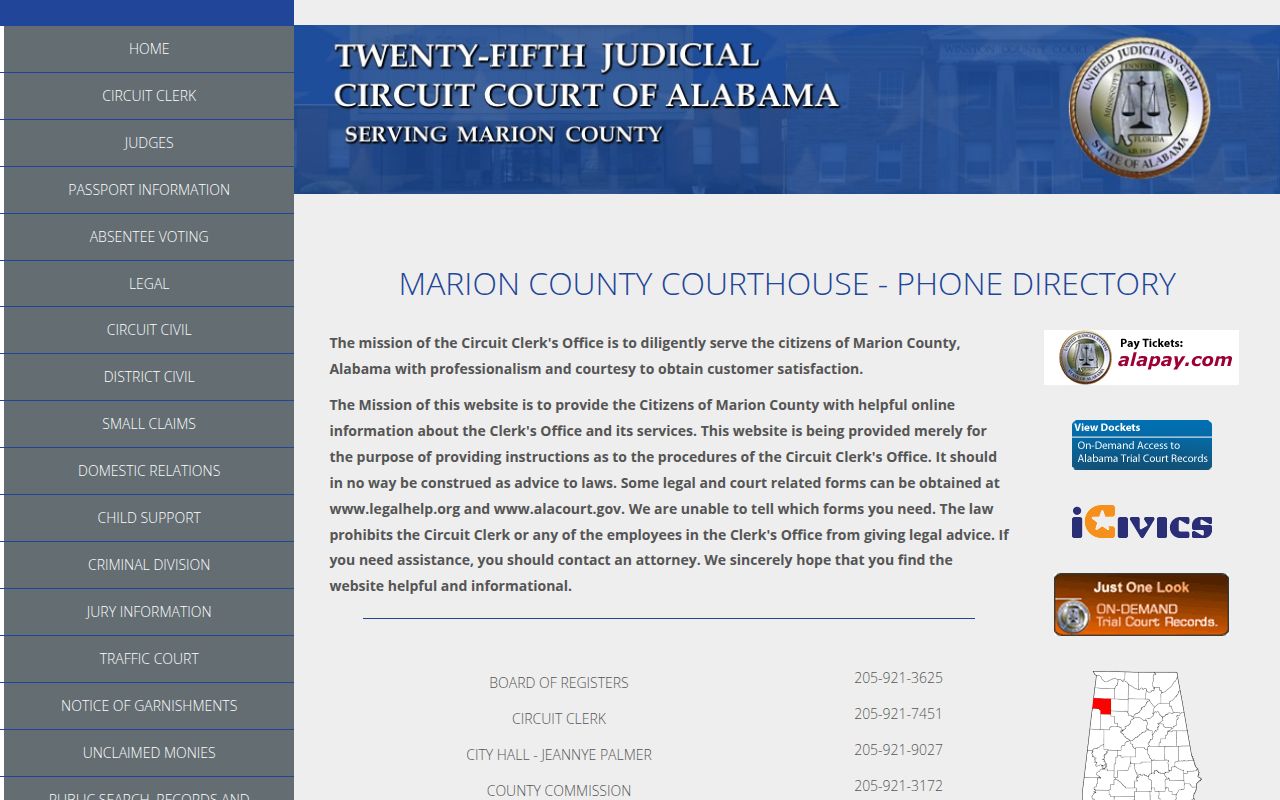
Marion County Circuit Clerk
The Circuit Clerk office is where you go for civil court records in Marion County. This office keeps all case files from the time they are filed until they are closed out and stored away. Staff can help you find cases and pull files for review. They can also make copies when you need them. The office sits in the Marion County Courthouse in downtown Hamilton on Military Street. It is the main spot for anyone who needs court papers or wants to look up a case.
| Circuit Clerk | Joy Cleghorn |
|---|---|
| Address | 132 Military Street S. Hamilton, AL 35570 |
| Phone | (205) 921-7451 |
| Hours | Monday - Friday, 8:00 AM - 4:30 PM |
When you go to the clerk office, bring a photo ID with you. If you know the case number, that helps a lot. Same goes for knowing the names of people in the lawsuit. The staff there can walk you through how to search for what you need. They deal with walk-in visitors all the time. Just explain what you are looking for and they will try to help. Keep in mind the office may close for lunch. Calling ahead saves time.
Online Access to Civil Court Records
Marion County gives you online access to civil court records through Alacourt. This is the same system all 67 Alabama counties use. So if you ever need to search records in another county, the process works the same way. You do not have to learn a new system each time.
Marion County Alacourt Portal
The Marion County Alacourt portal lets you search civil cases by party name or case number. Basic case info shows up free. This includes filing dates, case type, and who is involved. But to see the actual papers filed in a case, you need to set up an account. You also pay a fee for each case you want to view.
What You Can Search For
Alacourt covers civil lawsuits, small claims, family matters, and other civil filings. You can look up active cases or closed ones. The system shows case status and hearing dates. It also shows the list of filings. Some info might be blocked due to privacy rules. But most civil case basics are open to anyone who searches.
Search Fees for Document Access
Alacourt charges different rates based on the court level. District court case files cost $19.99 per case. Circuit court files run $29.99 per case. The basic search results are free to browse. You only pay when you want to open a case file and see the papers inside. If you just need to check if a case exists, you can often do that for free.
Alternative Search Methods
Not everyone wants to pay online fees. That is fine. You can go to the clerk office in Hamilton and use their public terminals to search records. Making copies there might cost less than online access. This is true if you only need a page or two from a case file. The staff can also pull paper files for you to look at. This helps for older cases that may not be online yet.
Types of Civil Cases in Marion County
Marion County courts handle all sorts of civil disputes. Which court your case goes to depends mainly on how much money is at stake.
Circuit Court Civil Cases
Circuit court takes the bigger cases. Under Alabama Code Section 12-11-30, circuit court has power over civil matters when the amount in dispute tops $20,000. These include serious injury lawsuits, large contract disputes, business fights, and real estate cases. The circuit court also handles equity cases like injunctions and quiet title actions. The dollar amount does not matter for those. These cases tend to be more complex. They take longer to resolve.
District Court Civil Cases
District court covers civil disputes up to $20,000 as set out in Alabama Code Section 12-12-30. Most debt collection lawsuits end up here. So do landlord-tenant disputes, car crash claims under the limit, buyer complaints, and smaller contract problems. The rules are a bit simpler than circuit court. Cases move through the system faster too.
Small Claims Court
Small claims is part of district court but has its own simpler rules. Per Alabama Code Section 12-12-31, small claims handles disputes under $6,000. This is where you go for minor contract issues, deposit disputes, or getting paid back for small debts. The whole point of small claims is to make it easy for regular people to use the courts. You do not need a lawyer. Forms are simple and hearings are informal.
Domestic Relations Cases
The Circuit Clerk also keeps records for family law matters. This includes divorces, custody battles, and child support cases. While these are separate from general civil cases, they often come up when you are looking into someone's court history. Property issues sometimes overlap with family disputes too.
Filing a Civil Case in Marion County
If you need to file a civil lawsuit in Marion County, here is what to expect. The process starts at the Circuit Clerk office in Hamilton.
Starting Your Case
You file your complaint with the Circuit Clerk along with the filing fee. The complaint explains who you are suing, why you are suing them, and what you want the court to do about it. For circuit court cases, you generally need a lawyer to draft these documents properly. Small claims has simpler forms you can fill out yourself.
Service of Process
After you file, the defendant has to be officially notified about the lawsuit. This is called service of process. Usually the sheriff or a process server delivers the papers to the defendant. Under Alabama law, proper service is required before the case can move forward. If the defendant cannot be found, there are rules about alternative service methods.
The Defendant Responds
Once served, the defendant has a set number of days to file a response. In circuit court, they typically get 30 days. In district court, it can be 14 days. If they do not respond in time, you can ask for a default judgment, which means you win because they did not show up to contest it.
Discovery and Motions
Circuit court cases usually go through discovery. This is where both sides share info and proof. It might include written questions, requests for papers, and depositions. Parties also file motions asking the judge to make rulings before trial. District court cases have less formal rules for all of this.
Trial or Settlement
Most civil cases settle before trial. But if you cannot reach an agreement, the case goes to trial where a judge or jury decides who wins. After trial, the losing party might appeal to a higher court if they think there were legal errors.
Civil Court Filing Fees
Filing fees in Marion County follow the statewide schedule established by Alabama Code Section 12-19-71. You pay these fees when you file a new case.
| Case Type | Filing Fee |
|---|---|
| Small Claims (under $1,500) | $35 |
| Small Claims ($1,500 - $6,000) | $96 |
| District Court Civil ($6,000 - $20,000) | $219 |
| Circuit Court Civil (under $50,000) | $197 |
| Circuit Court Civil (over $50,000) | $297 |
Other Costs to Expect
The filing fee is just the start. You also pay for service of process when the papers get sent to the defendant. If you need to call witnesses to court, there is a $12 fee under Alabama Code Section 12-19-74. Jury fees apply if your case goes to a jury trial. These extra costs add up. Budget for more than just the initial filing fee.
Copy and Certification Fees
Regular copies of court papers run about $0.50 to $1.00 per page. Certified copies cost more. They usually run $1.00 to $5.00 per page plus a fee on top for the seal. You need certified copies when you want to use a paper in another court case or for official purposes. Regular copies work fine if you just need something for your own files.
Fee Waivers for Low Income Filers
Court fees can be waived if you truly cannot pay them. You file a form that explains your money situation. The judge looks at it and decides if you can skip the fees. Being on public benefits helps your case. So does having very low income or being out of work. This makes sure everyone can use the courts even if they are broke.
Legal Framework for Court Records Access
Knowing your legal rights to see court records helps if you ever run into problems. Alabama law tends to favor public access to court records. Most of the time you can get what you need without much trouble.
Alabama Public Records Law
Alabama Code Section 36-12-40 gives every Alabama resident the right to look at and copy public records. The law says this should be read broadly in favor of letting people see records. If someone tells you that you cannot have a record, they have to prove why. You do not have to say why you want the record.
Court Record Privacy Rules
The Alabama Rules of Court-Record Privacy and Confidentiality took effect January 1, 2025. Rule 104(A) says court records are open for inspection and copying as a general rule. But certain things get protected: Social Security numbers, bank account numbers, details about minors, and other sensitive data. The clerk may redact this information before giving you copies.
Sealed Cases
Some civil cases get sealed by court order. This happens when there are trade secrets involved, settlement confidentiality agreements, or other reasons a judge decides the public should not see the file. You might see that a sealed case exists on the docket, but you cannot access the documents without getting the judge to unseal them first.
Statutes of Limitation
Different types of lawsuits have different deadlines for filing. Alabama Code Section 6-2-34 gives you six years for written contract claims. Injury and property damage claims have a two-year deadline under Section 6-2-38. Medical cases have special rules. There is a two-year limit plus a four-year cutoff no matter when you found out about the harm. These deadlines affect what kinds of recent cases you might find in the system.
Related Record Sources
Civil court records do not exist in a vacuum. Other types of public records often connect to civil cases and can give you a fuller picture when researching.
Judgment Liens and Property Records
When someone wins a money judgment in civil court, they can record it as a lien against the losing party's real property. These get filed with the Marion County Probate Court rather than the Circuit Clerk. Under Alabama Code Section 6-9-190, a judgment lien attaches to property in any county where it is recorded. If you are checking whether someone has debts or judgments against them, look at both the civil court records and the property records.
Marion County Probate Court
The Probate Court handles estates, wills, guardianships, and adoptions. It also records deeds, mortgages, and land transfers. While probate matters are separate from civil court, they sometimes overlap. Disputes over inheritances often involve civil litigation. Property transfers might relate to judgments being collected.
Federal Court Records
Marion County falls within the Northern District of Alabama for federal court purposes. Federal court in Birmingham handles cases involving federal law, bankruptcy proceedings, and disputes between residents of different states when over $75,000 is at stake. Search federal records through PACER at $0.10 per page. Larger business disputes and cases with out-of-state parties often end up in federal rather than state court.
Bankruptcy Records
Bankruptcy filings have a big impact on civil cases. When someone files bankruptcy, most civil collection efforts against them stop automatically. Existing judgments might get discharged or restructured through the bankruptcy process. The U.S. Bankruptcy Court for the Northern District of Alabama handles these matters, and records are available through PACER.
Legal Assistance Resources
Not everyone can afford to hire a private attorney. If you need help with a civil matter in Marion County, these organizations offer free or reduced-cost legal services to people who qualify.
Legal Services Alabama
Legal Services Alabama provides free civil legal aid to low-income residents throughout the state, including Marion County. They handle housing problems, consumer issues, family law cases, and public benefits disputes. There are income limits to qualify, but many people who think they cannot afford a lawyer actually qualify for these services. Call their statewide intake line at 1-866-456-4995 to find out if they can help you.
Alabama State Bar Lawyer Referral
The Alabama State Bar runs a lawyer referral service at 1-800-392-5660. You pay up to $50 for a 30-minute consultation with a lawyer who handles your type of case. This is a good way to get professional advice on whether you have a real case and what your options are, without committing to full representation right away.
Self-Help Resources
Alabama Legal Help offers free guides, forms, and explanations for people handling civil matters on their own. The site covers small claims procedures, landlord-tenant rights, consumer protection, and other common topics. If you cannot afford a lawyer and plan to represent yourself, this site walks you through how the process works.
Law Library Resources
The courthouse may have legal reference materials available for public use. Check with the clerk office about what they have on site. Some courthouses maintain collections of form books and practice guides. Law school libraries in Alabama are also open to the public and have more extensive resources if you are willing to travel.
Search Civil Court Records
Use the search tool below to find civil court records from Marion County and other Alabama locations.
Cities and Towns in Marion County
Marion County includes Hamilton (the county seat), Winfield, Guin, Hackleburg, Bear Creek, and several other small communities. Civil court records for residents throughout Marion County are all maintained at the county level by the Circuit Clerk in Hamilton. None of the cities in Marion County have populations over 100,000, so there are no dedicated city pages. However, you can search for records at the county level and the clerk office in Hamilton serves everyone in the county regardless of which town they live in.
Nearby Counties
The following counties border Marion County or are close by. Each one has its own Circuit Clerk office that maintains civil court records for that area.